EN
EN  EN
EN DA
DA NL
NL FI
FI FR
FR DE
DE IT
IT JA
JA KO
KO NO
NO PL
PL PT
PT RO
RO RU
RU ES
ES SV
SV TL
TL ID
ID SK
SK UK
UK VI
VI TH
TH TR
TR FA
FA BE
BE LA
LA UZ
UZ

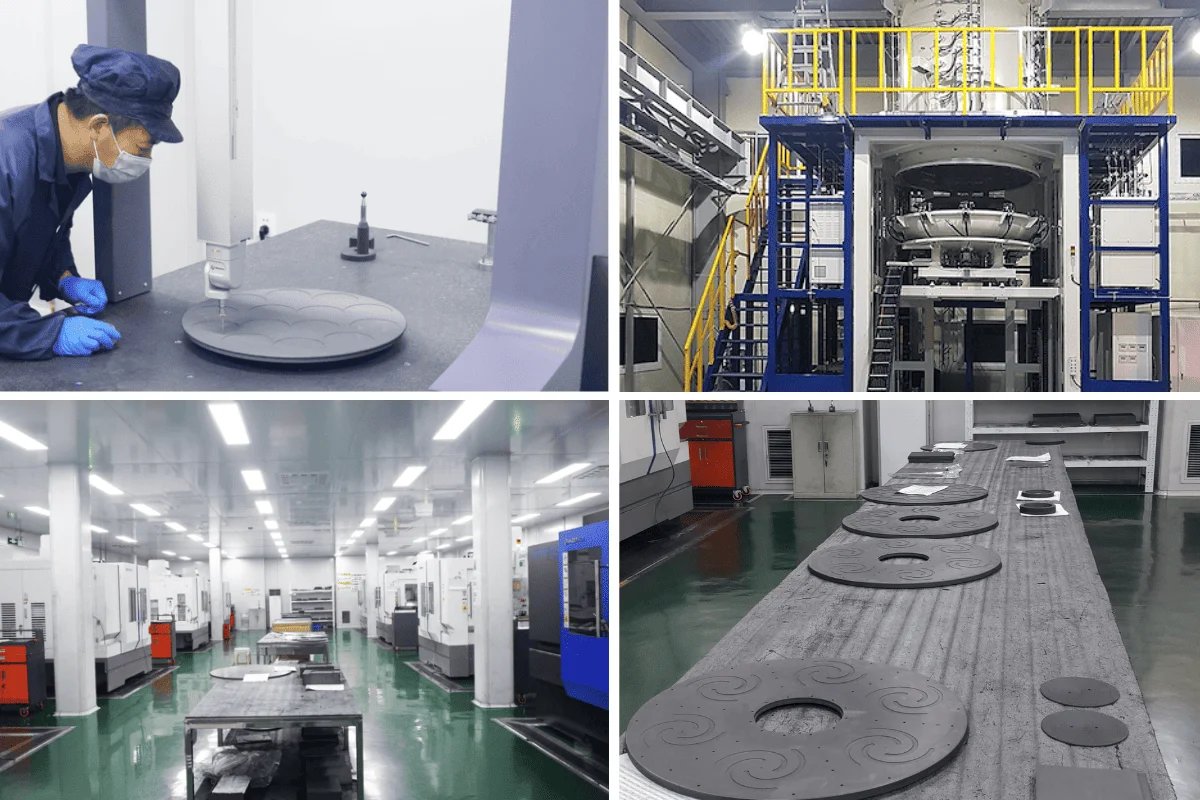
8-nti TaC coated Graphite Disc rau Epitaxial Loj hlob
Our 8-inch TaC coated graphite disc is a critical component for single-wafer horizontal sic epitaxial reactors, designed to support next-generation 8-inch SiC wafer production.With a graphite base and dense TaC protective coating, it provides exceptional thermal uniformity, chemical resistance, and contamination control during high-temperature epitaxial growth. Its precise gas-floating wafer support design minimizes particle generation,while the TaC barrier layer shields the graphite from corrosive process gases, ensuring wafer surface integrity and long component lifetime.
Hauj lwm
Semixlab 8-inch TaC coated graphite disc is a critical component specifically engineered for single-wafer horizontal SiC epitaxy reactors. Manufactured with a high-purity graphite substrate and coated with a dense layer of tantalum carbide (TaC), this disc delivers exceptional thermal stability, corrosion resistance, and particle suppression. It plays a vital role in achieving defect-free SiC epitaxial layers, meeting the strict requirements of next-generation power semiconductor device manufacturing.
Roles in SiC Epitaxy
In a single-wafer horizontal SiC epitaxial reactor, the 8-inch TaC coated graphite disc serves as a core functional platform directly influencing wafer quality, epitaxial layer uniformity, and overall reactor stability. Its role can be broken down into several key aspects:
1. Wafer Support & Gas-Floating Suspension
The disc provides a mechanical and thermal interface for the 8-inch SiC wafer. Through a precisely designed gas-floating mechanism, process gases such as H₂ flow between the disc and wafer, creating a stable suspension. This non-contact design reduces mechanical stress and minimizes the generation of micro-particle, which are critical factors for defect-sensitive SiC devices.
2. Heat Management & Uniform Temperature Distribution
SiC epitaxy requires extremely high growth temperatures (1500–1650 °C). The TaC-coated disc ensures even heat conduction across the wafer surface, suppressing hot spots and edge-cooling effects. By maintaining tight temperature uniformity (<±1–2 °C), the disc supports consistent epitaxial thickness and doping uniformity, which are crucial for high-performance SiC power devices.
3. Chemical Resistance & Graphite Protection
During epitaxy, corrosive gases such as HCl (etching agent) and hydrocarbon precursors (e.g., propane, silane) are introduced. The TaC coating acts as a dense, chemically inert shield that protects the graphite base material. Without this coating, graphite would gradually degrade, releasing carbon species into the chamber, leading to surface roughness, contamination, and yield loss.
4. Contamination Control & Defect Reduction
Carbon outgassing from unprotected graphite is a major contamination risk in SiC epitaxy. The TaC barrier prevents carbon sublimation, keeping the reactor environment clean. This directly reduces epitaxial defects such as triangular defects, stacking faults, and micropipes, ensuring device-grade wafer quality.
5. Process Stability & Long-Term Reliability
The disc operates under repeated thermal cycling in ultra-high temperatures. TaC’s ultra-high melting point (~3880 °C) and excellent thermal shock resistance extend the service life compared to uncoated graphite. Longer operational life means fewer disc replacements, leading to higher reactor uptime and lower cost of ownership for semiconductor fabs.
At Semixlab,we provide precision-engineered TaC coated graphite components designed to support the advancement of SiC epitaxy technology.Whether you are a process engineer seeking higher yield or a procurement specialist focused on reliable supply, our solutions deliver proven performance in demanding semiconductor environments. Looking forward to your further consultation.
Specifications
| Lub cev muaj zog ntawm TaC txheej | |
| ceev | 14.3 (g / cm³) |
| Tshwj xeeb emissivity | 0.3 |
| Thermal expansion coefficient | 6.3*10-6/K |
| Hardness (HK) | 2000 HK ib |
| Kuj | 1 × 10⁻⁵ Aw* cm |
| Thermal ruaj khov | <2500 ℃ |
| Graphite loj hloov | -10 ~ 20 hli |
| Txheej thickness | ≥20um tus nqi raug (35um ± 10um) |
peb pab

Semixlab khoom khw