
 EN
EN  EN
EN DA
DA NL
NL FI
FI FR
FR DE
DE IT
IT JA
JA KO
KO NO
NO PL
PL PT
PT RO
RO RU
RU ES
ES SV
SV TL
TL ID
ID SK
SK UK
UK VI
VI TH
TH TR
TR FA
FA BE
BE LA
LA UZ
UZ


TaC Planetary Epi Susceptor
| Qhov chaw ntawm keeb kwm: | Tuam Tshoj |
| Hom Npe: | Semixlab |
| Model Number: | TPES0001 |
| Certification: | ISO 9001 |
| Yam Tsawg Tshaj: | 1pc |
| Nqe: | Mekas |
| Ntim Paub meej: | Standard export box |
| Tus me nyuam lub sij hawm: | 30-45days |
| Ntsiab lus uas them: | Kom tau sib ceg |
| Mov Muaj peev xwm: | 200pcs per months |
Hauj lwm
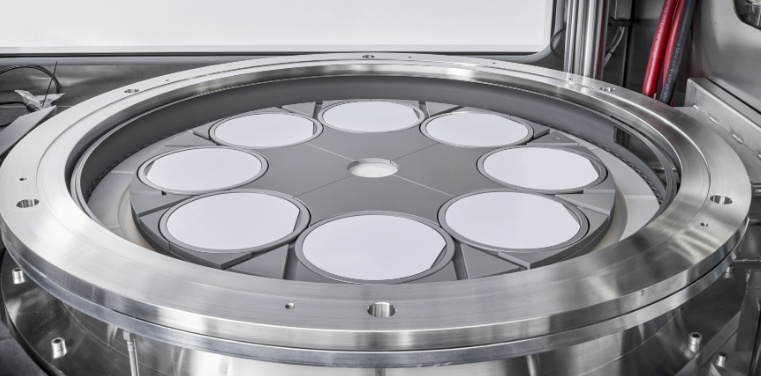
The Aixtron planetary disk is a key bearing component in metal-organic chemical vapor deposition (MOCVD) equipment, mainly used in the growth process of silicon carbide (SiC) epitaxial sheets. Its core structure adopts the composite design of high-purity graphite material + tantalum carbide (TaC) coating.
Nthuav Qhia:
1. Other names: Aixtron planetary disk,TaC coated planetary susceptor,SiC Epi susceptor for Aixtron reactor
2. Application: For high-performance silicon carbide (SiC), gallium nitride (GaN) and other third generation semiconductor epitaxial process.
3. Core parameters:
The structure remains stable at 2000℃ to avoid coating volatilization contamination of the reaction chamber.
Effective resistance to erosion of precursor gases such as SiH₄ and HCl. Reduces surface defects on the substrate.
The thermal conductivity of the graphite +TaC composite structure is close to that of the SiC wafer (SiC: 490 W/m·K), reducing the lattice distortion caused by thermal stress.
The surface roughness of TaC coating is < 1μm, which can inhibit the fall off of micro-particles and ensure the surface quality of epitaxial layer (defect density < 0.5/cm²).
 Saib ib muag khoom
The Aixtron planetary disk is a key bearing component in metal-organic chemical vapor deposition (MOCVD) equipment, mainly used in the growth process of silicon carbide (SiC) epitaxial sheets. Its core structure adopts the composite design of high-purity graphite material + tantalum carbide (TaC) coating:
Graphite substrate: provides excellent thermal conductivity (~130 W/m·K) and high temperature stability (temperature > 2000℃) to ensure a uniform thermal field distribution in the reaction chamber.
Tantalum carbide coating: The graphite surface is covered by a chemical vapor deposition (CVD) or sintered process, usually 30-100um thick, to form a dense chemical barrier.
The design is optimized for the high temperature (1500-1700℃), highly corrosive (silane, HCl and other gases) environment of SiC epitaxial growth, significantly improving process stability and wafer yield.
Tantalum carbide (TaC) and silicon carbide (SiC) coating performance comparison
| Txheej Khoom | Tantalum carbide (TaC) coating | Silicon carbide (SiC) coating |
| melting point | Melting point 3880℃ (higher temperature limit) | Melting point 2700℃ (easy to decompose at high temperatures) |
| Thermal expansion coefficient | Thermal expansion coefficient 6.3×10⁻⁶/K (better matching with graphite) | 4.5×10⁻⁶/K (easy to crack due to thermal mismatch) |
| Resistance to silicon vapor corrosion | Excellent resistance to silicon vapor corrosion (low TaC and Si reactivity) | poor (at high temperatures SiC reacts with Si to form gas phase Si₂C) |
| Particle pollution risk | Very low risk of particle contamination (dense coating without pores) | High (coating prone to local peeling) |
| lub neej | Service life > 5000 hours (extended maintenance cycle more than 50%) | Txog 2000-3000 teev |
Production compatibility
Adapted to Aixtron G5 WW C and Prophet platform, it can carry 6/8-inch wafers with a capacity of > 30 wafers/batch.
Technical value and industry significance
Graphite + tantalum carbide coated planetary susceptor solves the bottleneck problem of traditional SiC coating in the long-term high temperature process:
Cost optimization: extend the replacement cycle of consumables and reduce the epitaxial cost of a single piece by more than 20%;
Yield improvement: reduce particle pollution and heat spot effect, and promote the epitaxial sheet yield to exceed 95%;
Process window broadening: supports higher growth rates (> 50μm/h) and thicker epitaxial layers.
As global SiC capacity is upgraded to 8 inches, this technology will be a critical path to break through the epitaxial consistency bottleneck.
Specifications
| Lub cev muaj zog ntawm TaC txheej | |
| ceev | 14.3 (g / cm³) |
| Tshwj xeeb emissivity | 0.3 |
| Thermal expansion coefficient | 6.3 10-6/K |
| Hardness (HK) | 2000 HK ib |
| Kuj | 1×10⁻⁵ Ohm*cm |
| Thermal ruaj khov | <2500 ℃ |
| Graphite loj hloov | -10 ~ 20 hli |
| Txheej thickness | ≥20um tus nqi raug (35um ± 10um) |
| Thermal conductivity | 9-22 (W/m·K) |
| Lub cev muaj zog ntawm isostatic graphite | ||
| Khoom | Tsev | Tus Nqi Qub |
| Kev ceev ntau | g / cm³ | 1.83 |
| Hardness | H.S.D. | 58 |
| Hluav taws xob Resistivity | μΩ m | 10 |
| Kev Ua Tau Zoo | MPa | 47 |
| Hloov zog | MPa | 103 |
| Tensile Zog | MPa | 31 |
| Young's Modulus | GPa | 11.8 |
| Thermal Expansion (CTE) | 10-6K-1 | 4.6 |
| Thermal Kev Coj Ua | W·m-1·K-1 | 130 |
| Nruab Nrab Loj Loj | μm | 8-10 |
daim ntawv sau npe
Silicon carbide power device epitaxy
It is suitable for 4H-SiC homogeneous epitaxial growth, which is used to manufacture high-voltage MOSFET and IGBT devices above 1200V.
Demand for new energy vehicles, photovoltaic inverters, rail transit and other fields has surged.
Third generation semiconductor development
Supports GaN-on-SiC heteroepitaxy process for 5G RF devices and millimeter wave communication chips.
Kev Tshaj Loj (Competitive Advantage)
Summary of core advantages:
TaC coating is superior to traditional SiC coating in terms of corrosion resistance at high temperature, thermal matching and long life, especially suitable for silicon vapor enrichment environment in SiC epitaxial growth.
Resistance to extreme heat:
The structure remains stable at 2000℃ to avoid coating volatilization contamination of the reaction chamber.
Tshuaj ua hauj:
Effective resistance to erosion of precursor gases such as SiH₄ and HCl. Reduces surface defects on the substrate.
Thermal field uniformity:
The thermal conductivity of the graphite +TaC composite structure is close to that of the SiC wafer (SiC: 490 W/m·K), reducing the lattice distortion caused by thermal stress.
Low pollution output:
The surface roughness of TaC coating is < 1μm, which can inhibit the fall off of micro-particles and ensure the surface quality of epitaxial layer (defect density < 0.5/cm²).


